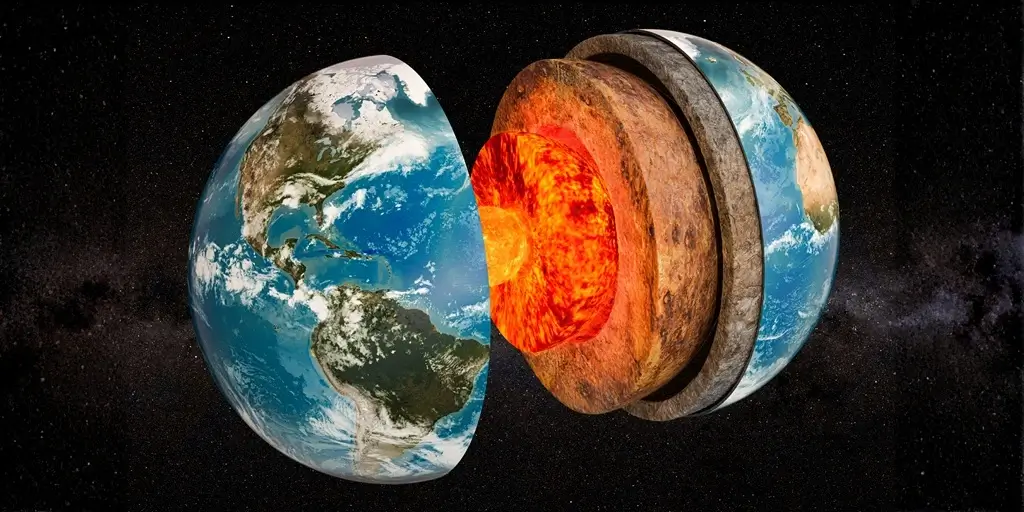
If you could look miles beneath the Earth’s crust, you wouldn’t find cold, lifeless rock. Instead, you would see heat and movement slowly reshaping the planet over millions of years.
This movement causes continents to drift, mountains to form, and earthquakes to happen. Understanding these forces is key to one of the main questions in GCSE Geography: how do tectonic plates move?
This guide explains the answer.
Here, we explore the processes in the Earth’s mantle, including how convection currents form, how forces like ridge push and slab pull move the plates, and how these processes shape the Earth’s surface.
Before examining the movement of the Earth’s crust, it is important to understand what convection currents are and how they work.
In simple terms, a convection current is a pattern of movement within a fluid or a plastic solid, caused by differences in temperature and density.
Within the Earth, convection currents occur in the mantle, i.e., the thick layer of hot rock located between the crust and the core. Although rock is usually thought of as rigid, mantle material, it acts like a very slow-moving liquid over geological timescales. This behaviour allows heat-driven movement to take place deep below the surface.
The Earth’s outer shell, called the lithosphere, is divided into several large and small tectonic plates. These plates rest directly on top of the semi-molten mantle.
As convection currents circulate within the mantle, they transfer movement to the plates above. A useful way to visualise this is to imagine large rafts floating on a slow-moving river: wherever the water flows, the rafts are carried along with it. In the same way, mantle movement drives tectonic plate motion.
For revision purposes, we’ve broken down the formation and impact of convection currents into five distinct stages below.
The journey begins nearly 4,000 miles beneath the surface. The Earth's core remains incredibly hot due to two main factors:
This intense thermal energy acts as the primary power source for everything that happens above it.
The mantle is not a liquid, but it isn't a rigid solid either. Instead, it behaves like a plastic or semi-solid, which means it can flow extremely slowly over millions of years.
As the core heats the lower mantle, the material becomes less dense and begins to rise. When it reaches the top of the mantle, just beneath the lithosphere, it spreads out, cools, becomes denser, and eventually sinks back toward the core. This continuous loop is known as a convection current.
The real tectonic plates that make up the Earth's outer shell float on the upper, more fluid part of the mantle, known as the asthenosphere. As the convection currents move horizontally beneath these plates, they create a friction-like drag. This mantle drag acts like a slow-motion conveyor belt, carrying the plates along with the current.
When the mantle material moves away from the heat source and travels beneath the cooler crust, it gradually cools. The rock becomes denser and eventually sinks back down towards the core, where it can be reheated.
This completes the circular flow of the convection current.
Over millions of years, the tectonic plate's movement has led to continental drift. It is the reason why a single, massive landmass known as Pangea eventually broke apart, shifting the continents into the positions we see on a map today.
This process is far from over as the continents continue to move at roughly the same speed as your fingernails grow.
While convection currents move the mantle, tectonic plates don’t simply float. Instead, they are influenced by their own weight and gravity. This process gives rise to two important forces: ridge push and slab pull, discussed in detail below.
At divergent boundaries, magma rises to create a new, hot crust. This rock rises above the surrounding seafloor. As it cools and becomes denser, gravity makes it slide downhill away from the ridge, pushing the rest of the plate forward.
So, what is slab pull? At convergent boundaries, a dense oceanic plate sinks into the mantle. Since this sinking slab is colder and heavier than the hot mantle, gravity pulls it down with immense force.
This tug is the primary reason plates move, dragging the entire plate behind it like a heavy anchor falling off a boat.
The interaction of tectonic plates is where we see the most significant impact on human life. The movement driven by convection further results in:
If visualising how heat from the Earth’s core can lead to a mountain range feels tricky, you’re not alone. One of the most effective ways to grasp the convection cycle is to see a diagram of tectonic plates in motion.
To help with this, the team at HRB Education has created a step-by-step video guide on convection currents for GCSE revision. Watch it now to see the process in action and reinforce your understanding.
So, why do tectonic plates move? The answer lies in a continuous, planet-wide recycling system driven by heat from the Earth’s core. Convection currents within the mantle, working alongside gravitational forces like ridge push and slab pull, drive the tectonic plates across the Earth’s surface in a slow and steady cycle.
Need more guidance on understanding the convection cycle in detail?
At HRB Education, we help students master these concepts step by step, so they can apply their knowledge clearly and accurately in exams. By grasping not just what happens beneath the Earth’s surface, but also why it happens, they gain an in-depth understanding of the planet they live on.
Would you like to discuss your study plan? Book a consultation with us today.
Sign up for the latest insights and updates.